Rani Channamma University, Belagavi

1. ABOUT


The Department of Studies and Research in Physics under the School of Basic Sciences was established in the academic year 2011 and offers Master of Science (M.Sc.) and Ph.D. programmes in Physics. The department was started with an intention to strengthen science education in the northern part of Karnataka. The present intake for the M.Sc. course is 45, and admission is based on the merit-cum-roster system as per the Govt. of Karnataka. The department follows the CBCS Scheme syllabus. The Department of Physics is equipped with modern laboratory equipment and currently offers Condensed Matter Physics as a specialization. In the future, the department intends to start other specialization subjects such as Nuclear and Particle Physics, Atomic, Molecular and Optical Physics, Electronics, and related interdisciplinary courses. Faculty members of the department have generated external research funds to the tune of 1.2 crores and are involved in designing and building research instruments. Several students of the department have cleared the SLET examination, and a considerable number of students are pursuing research in various Universities.

Vision

To make the Department of Physics under the umbrella of Rani Channamma University, the most preferred centre of higher education in the areas of Condensed Matter Physics, Nuclear and Particle Physics, Atomic, Molecular and Optical Physics, and Electronics.

Mission and Goals

  • To create an opportunity for meaningful learning in the areas of Physics for the students in the region.
  • To develop the human capital from this region to contribute to the growth of Science and Technology.
  • To develop world-class teaching and research laboratory facilities for training students for higher education and job opportunities.
  • To develop a center of research and higher education for the social development of the region.
  • To carry out research in interdisciplinary areas in collaboration with other departments under the university, other institutions of higher learning & research, and industry.

Achievements

  • Generated about Rs. 1 Crore in the form of research funds from various government agencies.
  • Design and development of Vibrating Sample Magnetometer to measure magnetic properties of magnetic samples.
  • More than 50 research publications in reputed international journals in the last five years.
  • Several students joined for Ph.D. and post-doctoral positions in national/international repute institutions.

2. PROGRAMMES


M.Sc. Physics
Eligibility B.Sc. with Physics
Admission Criteria Merit List (Consolidated Marks in Physics subject in B.Sc. Course)
Mode of Study Regular
Programme Duration 2 Years
Scope Teaching & Research
Career Prospects Higher education, Research, Industry and teaching positions
Admission Procedure Merit cum reservation
Ph.D. Physics
Eligibility M.Sc. Physics
Admission Criteria Merit List
Mode of Study Regular (Part Time & Full Time)
Programme Duration 3 Years
Scope Teaching & Research
Career Prospects Industry, Teaching in higher educational institutes, Post Doctoral positions.
Admission Procedure Merit cum reservation

3. SYLLABUS


Information will be updated soon.

4. PROGRAMME SPECIFIC / COURSE OUTCOME


Programme Outcomes (POs)

  1. Disciplinary knowledge
  2. Communication Skills
  3. Critical thinking, Reflective thinking, Analytical reasoning, Scientific reasoning
  4. Problem-solving
  5. Research-related skills
  6. Cooperation/Teamwork/Leadership readiness/Qualities
  7. Information/Digital literacy/Modern Tool Usage
  8. Environment and Sustainability
  9. Multicultural competence
  10. Multi-Disciplinary
  11. Moral and ethical awareness/Reasoning
  12. Lifelong learning/Self-Directed Learning

Programme Specific Outcomes (PSOs)

  1. Advanced Knowledge in Specialized Areas: Post Graduates will possess a deep understanding in fields such as Classical Mechanics, Quantum Mechanics, Classical Electrodynamics, Statistical Mechanics, Mathematical Physics, nuclear and particle physics, and condensed matter physics, including computational techniques for solving complex problems.
  2. Research and Problem-Solving Skills: Capability to design and conduct experiments, analyze data, and develop models to address contemporary issues in academic or industrial research. Proficiency in literature review, critical evaluation of scientific papers, and integrating new findings into research.
  3. Computational and Technical Proficiency: Mastery of mathematical tools for simulations, data analysis, and modeling in physics. Experience with modern experimental techniques and instrumentation (e.g., lasers, detectors, thermoelectric devices).
  4. Communication and Professional Development: Effective scientific communication through presentations, reports in class seminars and laboratory, and publications of project works in conferences and peer-reviewed journals. Awareness of ethical, societal, and environmental impacts of physics research and applications.

Course Outcomes (COs)

  1. Advanced Theoretical Knowledge: Gain a deep understanding of core physics subjects such as Quantum Mechanics, Classical Mechanics, Electrodynamics, Statistical Mechanics, and Condensed Matter Physics. Apply mathematical and computational techniques to solve complex physics problems.
  2. Experimental and Research Skills: Develop proficiency in laboratory techniques, data analysis, and instrumentation used in modern physics research. Conduct independent research projects, including literature review, experimental design, and scientific reporting.
  3. Specialization in Advanced Physics Domains: Acquire expertise in specialized fields such as Condensed Matter Physics.
  4. Computational and Analytical Proficiency: Use computational tools (e.g., ORIGIN) for analyzing experimental data. Apply statistical and numerical methods to interpret scientific results.
  5. Scientific Communication and Professional Development: Present lab experiments through technical reports, seminars, and publications. Develop skills for careers in academia, R&D, data science, and industrial research.

5. CHAIRPERSON


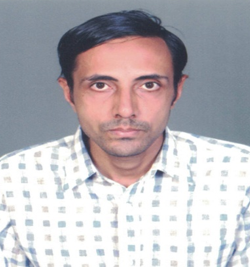
Prof. Balachandra G. Hegde
Name: Prof. Balachandra G. Hegde
Designation: Professor
Email-id: bghegde@rcub.ac.in
Mobile Number: +91 8277336421
Period of Chairmanship: 18-09-2015 to 17-09-2017 & 11/04/2018 to Present

6. FACULTY


Prof. Balachandra Gajanan Hegde

Prof. Balachandra Gajanan Hegde

Designation: Professor and Chairman
Qualification: M.Sc., Ph.D.
Email-id: bghegde@rcub.ac.in
Mobile: +91 8277336421
Resume: View Resume

Professor Hegde received his M.Sc. in Physics from Karnatak University, Dharwad, in 1989 and a Ph.D. in Condensed Matter Physics from Bangalore University in 2002. He worked on radiation damage pathways in solids using EPR. From 2002 to 2012, he was a post-doctoral research associate and research scientist at the University of Southern California (USC), Los Angeles, focusing on structural studies of proteins using Pulse EPR. He joined Rani Channamma University in 2013. His research interests include magnetic ordering in nanoparticles, multiferroic materials, and developing instrumentation for magnetic property studies. He has over 60 publications and is handling three major research projects worth Rs. 80 Lakhs. He is also the Nodal Officer for the PM USHA scheme.


Dr. Bhushan Anil Kanagalekar

Dr. Bhushan Anil Kanagalekar

Designation: Assistant Professor
Qualification: M.Sc., Ph.D.
Resume: View Resume

Dr. Kanagalekar completed his M.Sc. in Physics from Karnatak University, Dharwad, in 2006. He qualified for GATE and CSIR-NET-JRF and pursued his Ph.D. in Experimental Nuclear Physics at IIT Bombay. His thesis was on "Study of high spin states of I-126 populated using heavy ion fusion reactions." He joined Rani Channamma University in 2013. His research interests include Experimental Nuclear Physics, Theoretical Condensed Matter Physics, and Ancient Indian Mathematics and Astronomy.

7. RESEARCH


Research Profiles

Prof. B. G. Hegde: Experimental Condensed Matter Physics, including magnetic ordering in nanoparticles, multiferroic materials, structural studies of proteins using EPR, developing instrumentation for magnetic properties, Hall effect studies, and thin film deposition.

Dr. Bhushan A Kanagalekar: Experimental Nuclear Structure and Reactions, Theoretical Condensed Matter Physics, Provenance and Grouping studies of Archaeological samples, and Ancient Indian Mathematics and Astronomy.

Major & Minor Research Projects

# Faculty Project Title Funding Agency Amount (Lakhs) Year/Duration
1 Prof. B. G. Hegde Monodisperse Manganite Nano Particle Synthesis... VGST (KFIST L1), GoK 20 2014-15 (2 years)
2 Investigations into structural organization... of alpha-synuclein DBT North East Twinning program 25 2017-18 (3 years)
3 Optoelectronic applications of dye sensitized ZnO nano structures. VGST (KFIST L1), GoK 40 2016-17 (2 years)
4 Magnetic Ordering and Colossal Magneto Resistance... RCUB Teacher Research programme 0.775 2017-18 (1 year)
5 Development of Method to Detect Spin Fluctuations... PM USHA MERU Soft component RCUB 1 2025-26 (Ongoing)
6 Dr. Bhushan Kanagalekar Fusion Reaction Studies with Weakly Bound Nuclei BRNS, Mumbai 24 2019-20 (3 years)
7 Green Nanotechnology Based Fabrication of Electrode Materials... PM USHA MERU Soft component RCUB 1 2025-26 (Ongoing)

8. ACTIVITIES (2021-2025)


Curricular and co-curricular activities are conducted in the department every semester.

Academic Year: 2024-25

A special talk on “Earthquake Prediction Using VLF Radio Technique” was arranged on June 22, 2024. Dr. Prasanna Waichal from Waichal Research Institute, Ichalkaranji, was the chief guest and elaborated on early earthquake detection and risk minimization.

Academic Year: 2023-24

A Quiz Program and a Science Talk were conducted on April 11, 2023. The quiz covered various science topics. The science talk, "Recent Trends in Condensed Matter Physics," was delivered online by Dr. Samvit G. Menon, a Marie-Curie Fellow.

Academic Year: 2022-23

An online NET/SET coaching workshop was held on August 3, 2022. Dr. M. M. Pattanshetty was the chief guest and provided guidance on paper-solving skills.

Academic Year: 2021-22

An induction program for newly admitted students was held on January 12, 2021. Prof. J. Manjanna, Department of Chemistry, was the Chief Guest and motivated students to pursue higher education with excellence.

9. FACILITIES


The Department of Physics is equipped with state-of-the-art instruments for M.Sc. lab and for Research. Following is a list of some of the instruments for student use:

EPR Spectrometer

EPR Spectrometer (BRUKER) - Donated by Prof. S. V. Bhat, IISc Bangalore

UV/VIS Spectrophotometer

UV/VIS Spectrophotometer UV 3092

10. POLICY DOCUMENTS


No information to share.

11. ALUMNI


Alumni Coordinator Name: Dr. Bhushan Kanagalekar

Alumni Statistics (Pass out Students)

Year Total Students Pass Out Students
2023-24 32 31
2022-23 32 31
2021-22 31 26
2020-21 41 37
2019-20 36 32

Alumni Achievements

Sameena Mulla

Name: Sameena Mulla
Designation: Ph.D. student
Working for: NCU & COMU JNCASR, Bangalore
Email: samina@jncasr.ac.in

Dr. Akshayakumar Kompa

Name: Dr. Akshayakumar Kompa
Designation: Research Fellow (Postdoc)
Working for: Engineering Product Development, Singapore University of Technology and Design (SUTD)
Email: akshayakumarkompa@gmail.com

12. CONTACT US


Department Contact Information

Postal Address:
Department of Physics, Rani Channamma University, Vidyasangam NH-4, Belagavi-591156

Phone: 8277336421, 8618177989

Email-id: physicsdept@rcub.ac.in